
How to Catch Pompano from the Beach
Where pompano feed on a sandy beach, how to fish the trough and dig sand fleas, how to tell a permit in your hand, and the Florida keeper rules.
Where do pompano feed on a beach?
Most beach anglers throw past the fish, because pompano feed in the trough right at their feet.
Read the sand before you look at the horizon. The wash is the strip the last wave just covered. Outside that, the bottom drops into a trough, then rises onto the bar, the shallow ridge you can often pick out as a lighter line or a line of white water. A cut is a deeper slot through that bar, where the water pours through. That close water is the cast. The long one, out past the bar, comes only after a bait is already fishing in close.
They live in inshore and nearshore water, especially along sandy beaches, and also on oyster bars and over seagrass, often where the water is turbid. A beach stirred milky after a blow is still their water. They've been found as deep as 130 feet, but that's boat water, so fish the beach you're standing on.
They crush hard-shelled prey with big plates in the throat, which is why a sand flea or a small clam is the bait.
Fort De Soto has almost three miles of white sandy beach, so it's the place to start on this coast. Walk that sand and read the trough, the bar and any cut in front of you.
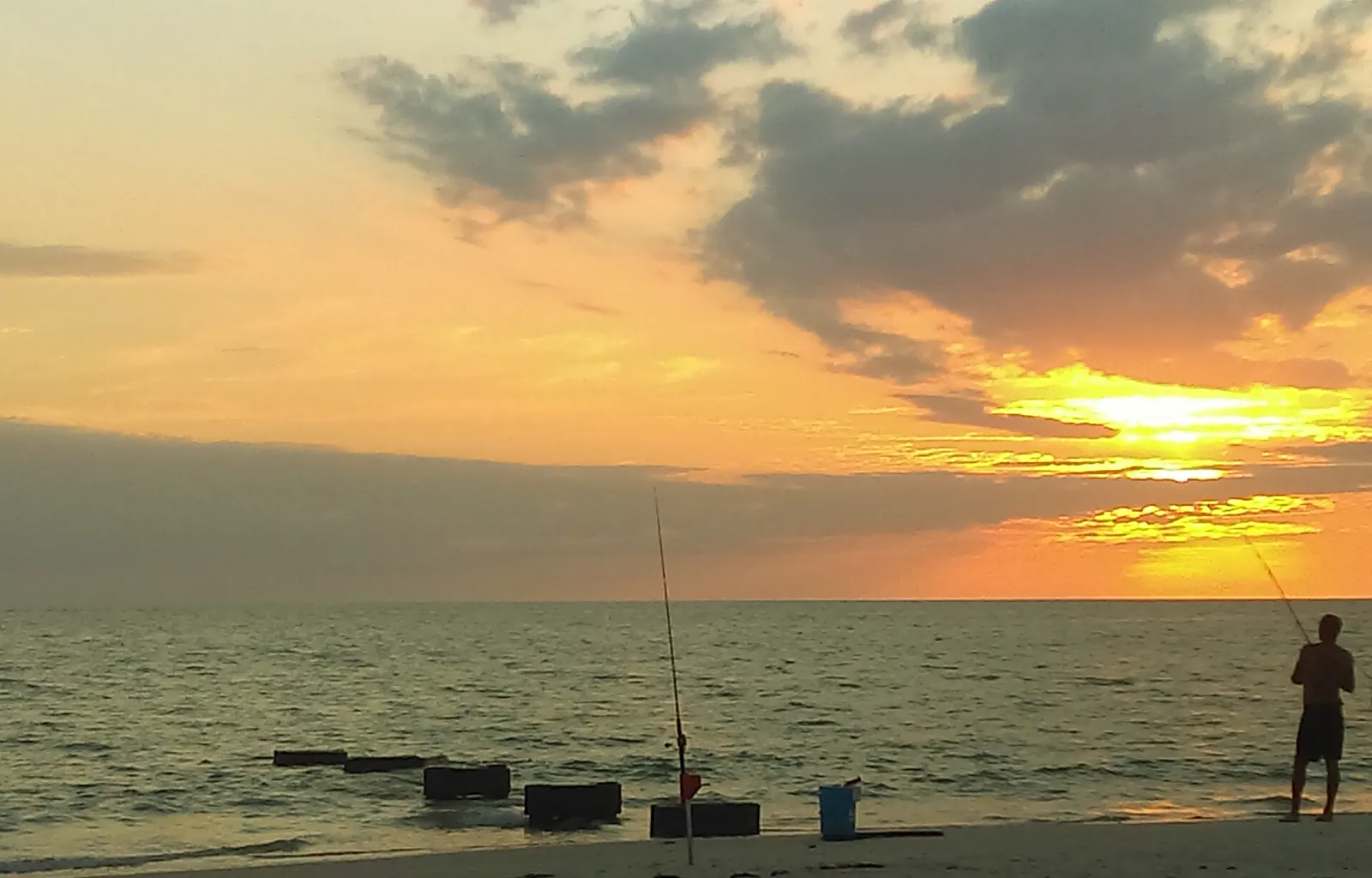
Stand far enough back from the wash that the next wave leaves the spike alone, and far enough that you can see the bar. The first rod goes in the trough. If a cut shows, the next rod goes through it, still short of the outside edge. Add distance last.
You can be out there for hours with the rods sitting in sand spikes. The sun comes off the sand and the water at the same time, and December doesn't change that. A Strike Zone Men's Sun Shirt is the layer for those hours, sleeves down, while you watch the tips.
When do they show up?
They are found in Florida year-round. Along the coast they move north and south with the 15°C isotherm in nearshore water. That's 59°F. A mild week and a hard cold week make for different water.
Before you leave the house, check the water temperature at the NOAA station on Clearwater Beach, number 8726724. At 9 a.m. on November 23, 2026 it read 70.3°F. That's comfortably above 59°F, but it's one reading, so check again the morning you go. If a hard front has already dropped the nearshore water, read the cold front guide before you commit the day to the beach.
They spawn offshore from March to September, and the peak of that spawning is spring and fall. A fish in the wash is a feeding fish.
What rig and what bait?
Tie a dropper with two single hooks and a pyramid sinker at the end. The pyramid digs into the sand and holds where you put it. A round weight rolls in the wash and walks the bait off that spot. Each hook hangs on its own short leader above the sinker, so the bait sits up instead of buried. One hook rides a little higher than the other, which covers more of the shallow water than a single bait lying in the sand. Use single hooks. A treble with bait on it is a rules problem, and that problem is spelled out in the rules section.
Put the rod in a sand spike. Reel until the line is tight and you can feel the sinker, with a little load in the tip so a change shows. A bow of slack hides the bite. When the tip does something new, set the hook, then get tight again. If the tip goes dead and stays dead, reel down until you find the sinker before you decide the beach is empty.
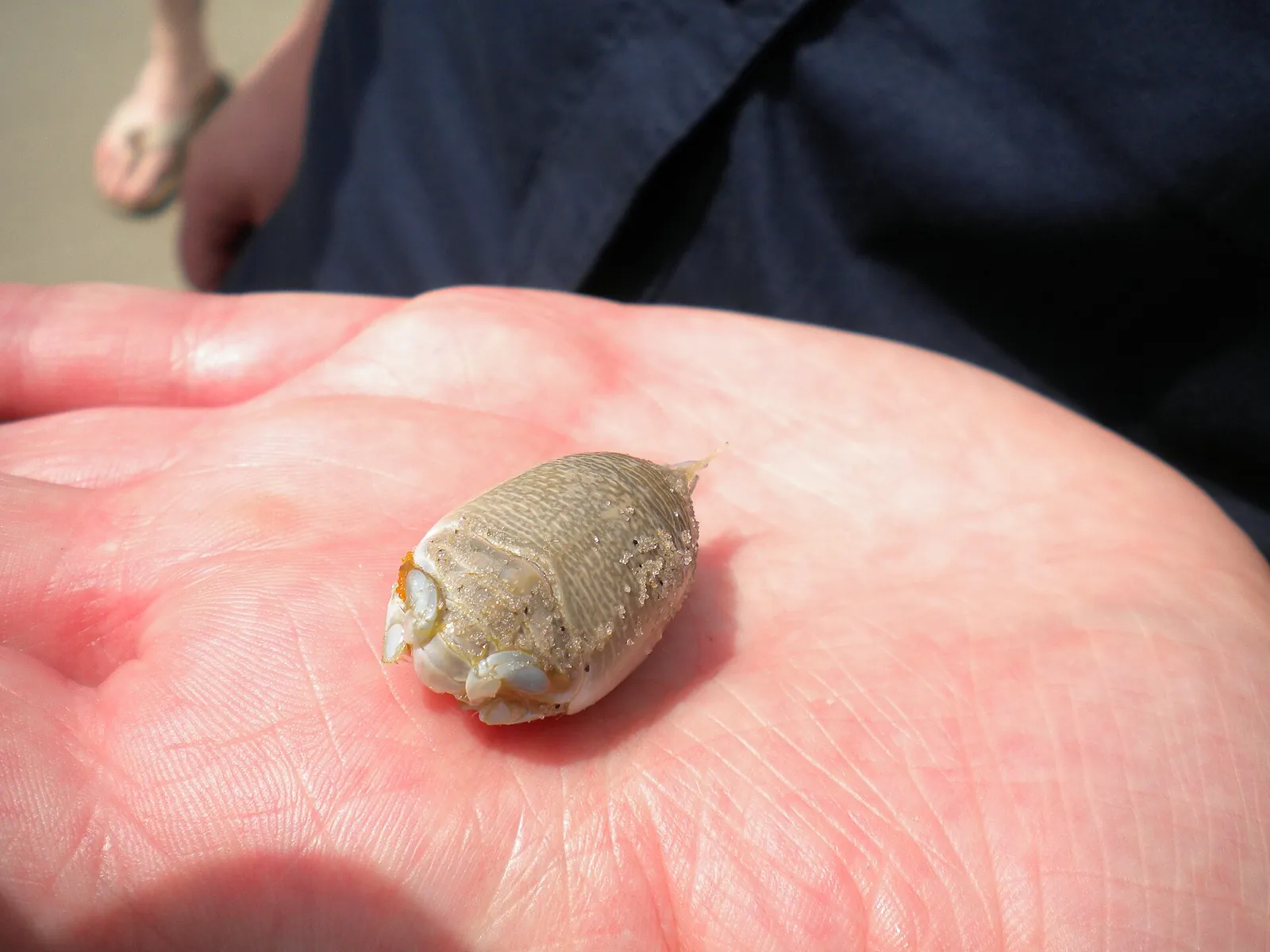
Sand fleas are mole crabs. They make little holes in the wet sand and hide in them between tides. They have five pairs of legs and no pincers, and they walk backward. You find them in the sand where the edge of the waves crashes. Females grow to about an inch and males to about half an inch. A sand flea is a crab that quit the claw business and learned to back into the sand.
Dig them the morning you fish, at the swash line, in the pause after a wave pulls back and before the next one fills the holes. Scoop that wet sand with your hands. Keep the crabs in a little wet sand so they last until they go on a hook. If the wash gives you nothing, shrimp is the backup. Adult pompano in Tampa Bay chiefly eat mussels and penaeid shrimp, so a shrimp is food they already take.
How do I work the trough and the tide?
Their local movements follow the tide, so fish while the water is moving. Read the chart the night before, while the rods are still in the truck. The tide chart guide is the plain version of how to do that. Know when the water runs during the hours you can be there, and be on the sand for that stretch.
When you move the rod, start close again. One bait in the near water, then a second through a cut if the bar has one. As the tide climbs, the wash moves up the beach and the spot you started in can end up in the wrong place relative to the bar. Pull the spike and reset it. As the tide falls, the bar shows itself and the cuts get easier to see, so walk to them. Fish following the tide can be down the beach from where you began. Pass the stretches where the trough has flattened out and there is nowhere to put a bait.
Set the spike firm, and check it when the wash moves. A rod on its side loads up with grit, and a rod the tide walks off with ends the morning. Line tight, spike planted, and you can dig bait or walk to the next cut.
Is it a pompano or a permit?
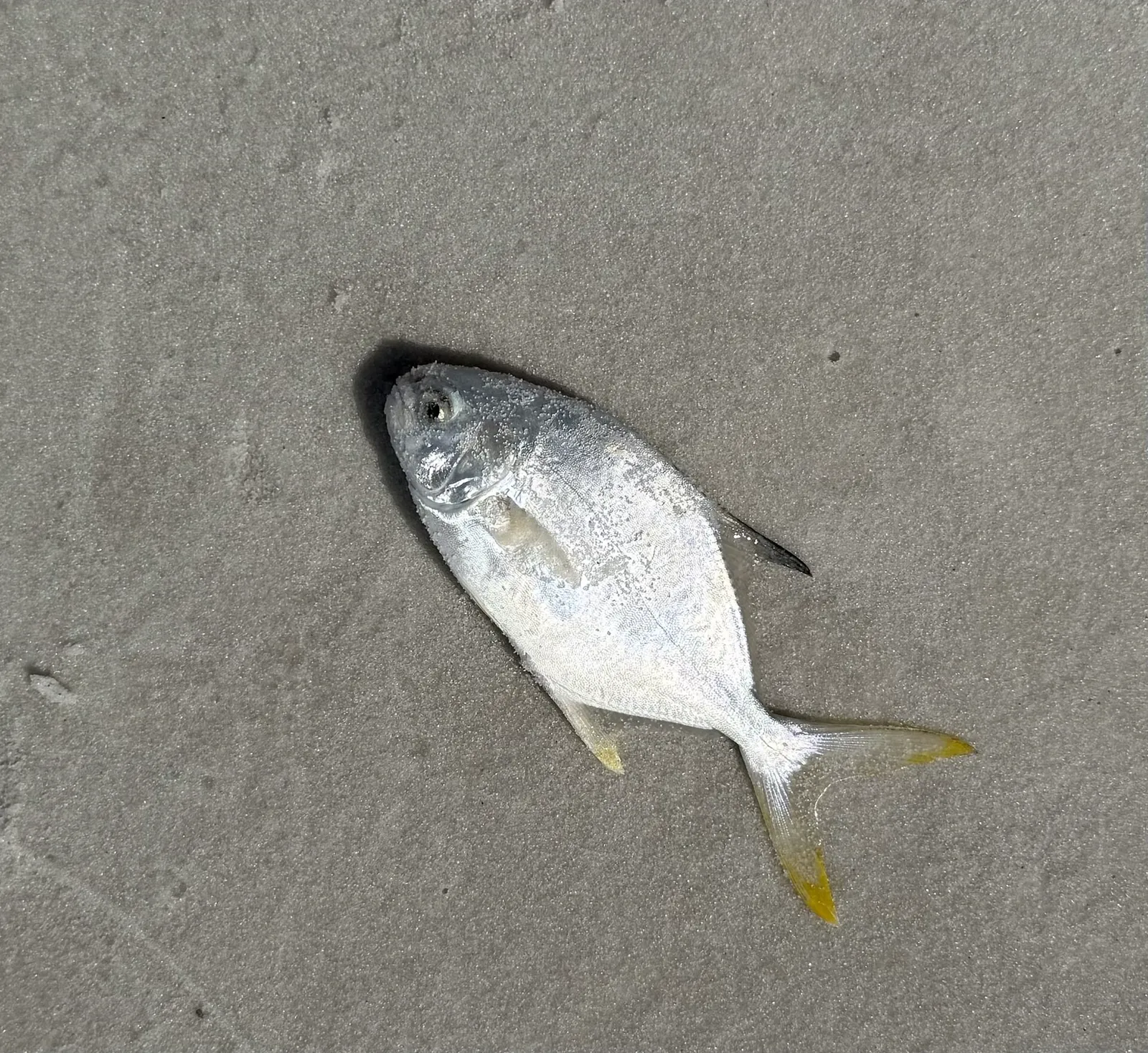
Florida pompano are common to 6 pounds and may reach 8, and they grow to 25 inches fork length. Permit are common to 40 pounds and may reach 50, and they grow to 48 inches fork length. If it feels like it could pull you down the beach, you're not holding a pompano. For a short fish that could be either, go to the fins.
The check you can do in your hand is the dorsal fin. On a pompano it begins forward of the anal fin. On a permit it begins over the anal fin. The tail agrees with that split. A pompano's tail has a wider fork than a permit's. Teeth on the tongue settle a small fish: a pompano has none at any size, and a small permit has them. Look at the tongue. Fish that have been in dark water have yellow on the throat, the pelvic fins and the anal fin. A pompano's body is deep and compressed, with a small mouth, a dark greenish gray back, silver sides and a yellowish belly.
Look before it goes in the cooler. A short silver fish can be a permit, and a permit is under a different rule. That rule is in the next section. Check the fish before you keep it.
What can I keep?
Rules change, so check the FWC page the week of the trip. The keeper rules below are how they read on November 23, 2026.
Florida pompano are open year-round. The minimum is 11 inches fork length, and the bag is 6 per harvester per day. Allowable gear is hook and line, cast net, and beach or haul seine only. Harvest is prohibited with any multiple hook in conjunction with live or dead natural bait, and snatching is prohibited. Snatching means hooking the fish in the body on purpose, anywhere but the mouth.
Fish have been found mature at about 10 inches fork length, so a fish just under 11 inches can already be an adult. The short ones go back in the water.
The gear rule defines a multiple hook as a treble hook, two or more fishhooks bound together to comprise a single unit, or any hook with a single shank and eye and two or more pointed ends. A dropper with separate single hooks passes that rule, because each hook has one point and hangs on its own leader. A treble hook used with live or dead natural bait is the combination the rule prohibits.
The Special Permit Zone covers the water south of Cape Florida and Cape Sable, so Tampa Bay and these Gulf beaches are outside it, and the outside-the-zone rule below is the one you fish under.
Outside the zone the slot is 11 to 22 inches fork length. You may keep one fish over 22 inches, and that fish is included in the bag rather than added on top of it. The bag is 2 per harvester. A vessel may have no more than 2 fish over 22 inches. The season is open year-round. In state waters the gear is hook and line only. Federal waters also allow spearing.
More from Alafia Cast Co
Licenses and regulations
The habitat, the identification and the keeper rules here come from these pages.
FWC permit, Florida pompano and African pompano regulations · FWC Florida pompano species profile · FWC permit and Florida pompano identification · FWC FWRI Florida pompano 2024 status and trends (PDF) · FWC fish measurement · FWC saltwater recreational licenses and permits · FWC: Do I need a license or permit? · Florida Administrative Code 68B-4.002 gear definitions · NOAA Tides and Currents, Clearwater Beach station 8726724 · USFWS Southeast Region mole crab, Blackbeard Island, Georgia · Pinellas County, Fort De Soto Park
FWC’s current saltwater and freshwater fishing rules. Regulations change.