
How big do alligator gar get?
Alligator gar can top 300 pounds and live for decades. How big they get, how old the giants are, where they live, and the Texas rules for keeping one.
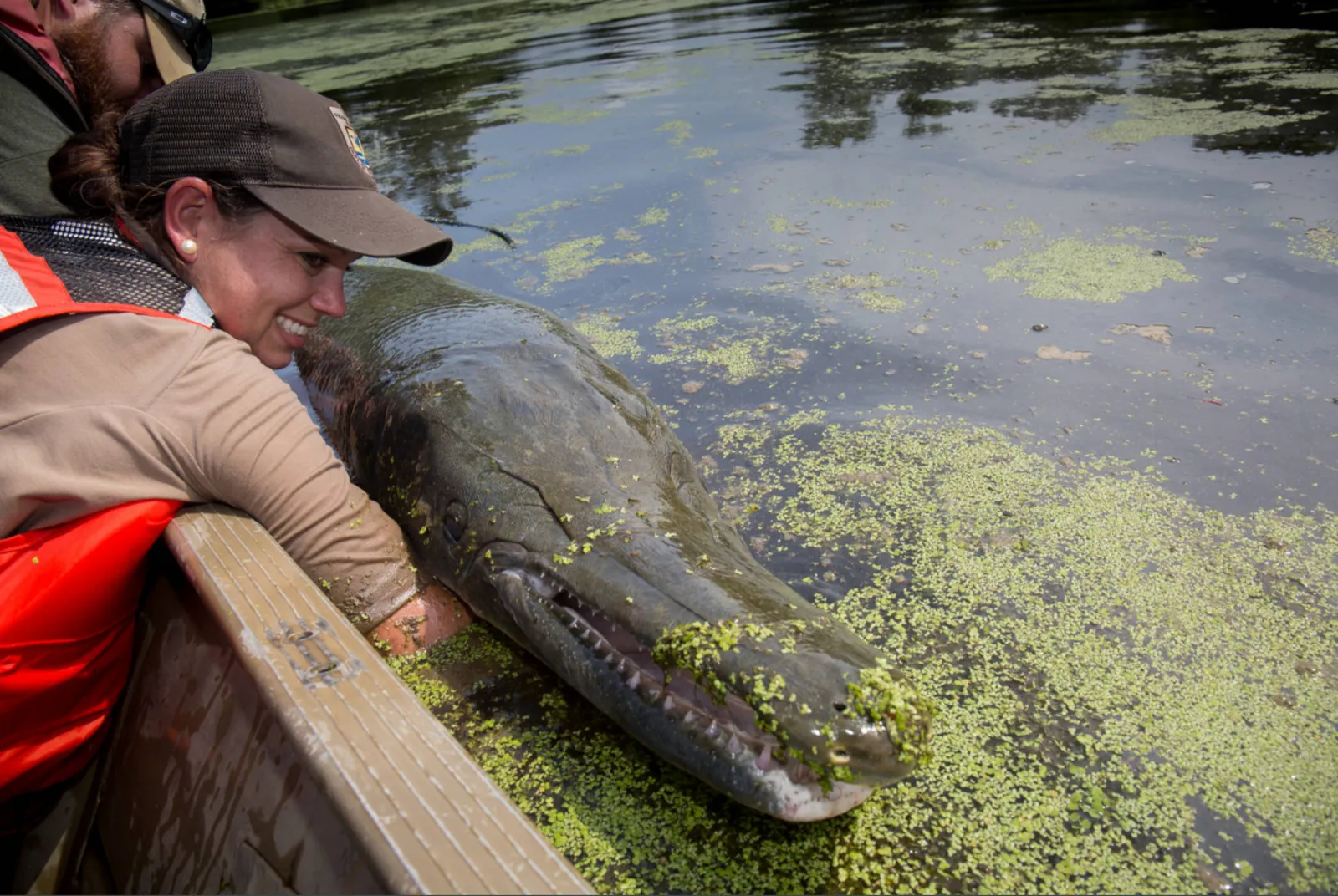
A fish built like armor
The alligator gar looks like something from another age, and in a way it is. Gar have changed little in a very long time, and the U.S. Fish and Wildlife Service traces their fossil record back about 100 million years. The fish has a broad, flat snout, two rows of big teeth on each side of the upper jaw, and a body covered in hard, diamond-shaped scales. Its scientific name, Atractosteus spatula, comes partly from the Latin word for spoon, after that wide snout.
How big they get
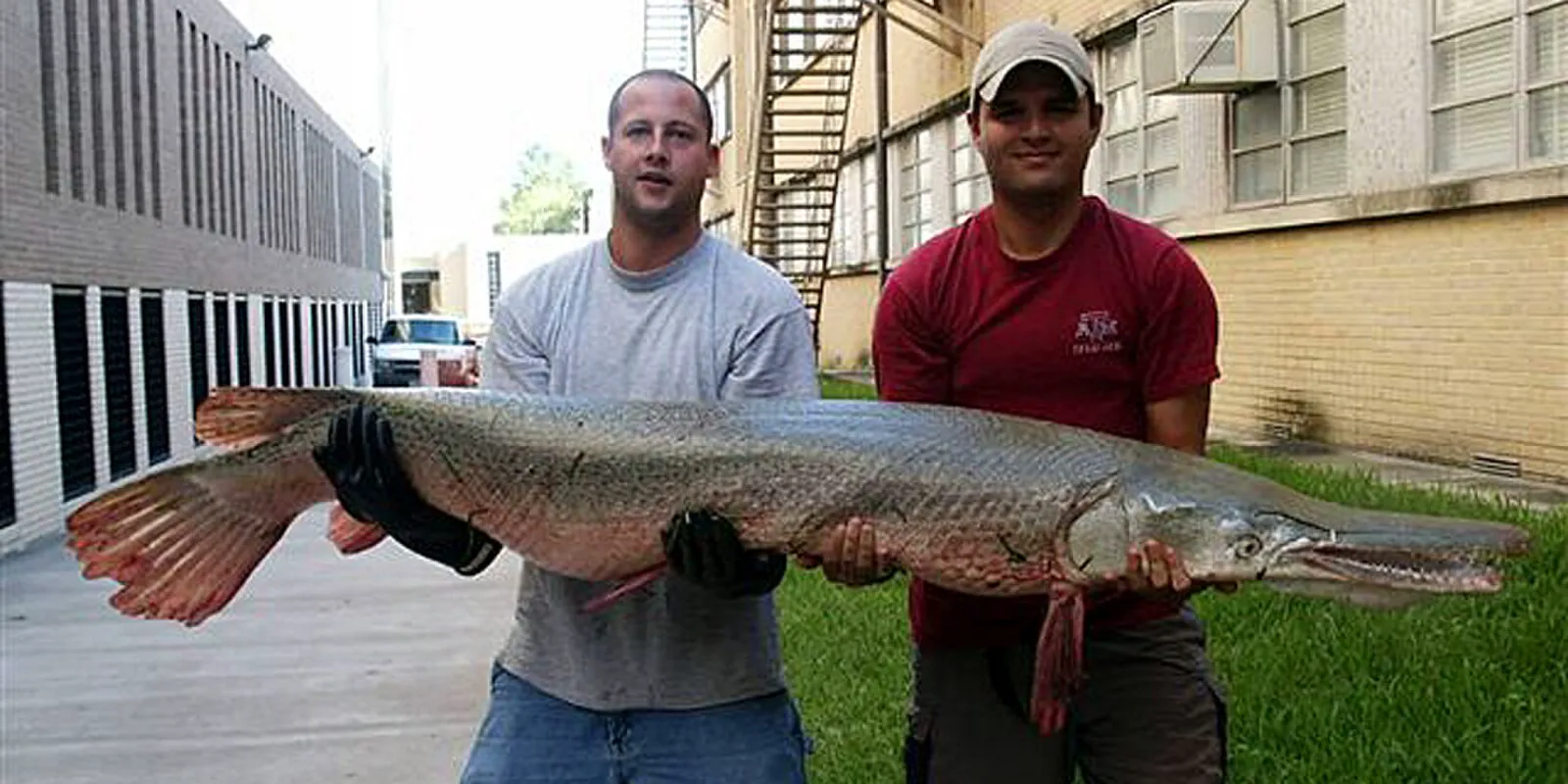
Texas Parks and Wildlife calls the alligator gar the largest of all the gars, at up to 8 feet long and more than 300 pounds. TPWD's identification page calls it the second-largest freshwater fish in North America, behind only the white sturgeon.
- The biggest on record: 327 pounds, from Mississippi in 2011
- The Texas state record: 302 pounds, caught on a trotline in 1953
- The Texas rod-and-reel record: 279 pounds
- Fish over 200 pounds: TPWD says several have been landed in Texas by bowfishers and rod-and-reel anglers
The giants are old
Size and age go together in a surprising way. TPWD's management page says that for each extra foot of length, a gar's age roughly doubles. A 3-foot gar is about two and a half years old and a 4-footer about five, but a 7-foot gar might be 40. TPWD estimates the 327-pound record fish was probably at least 95.
They're slow to start a family, too. TPWD says alligator gar don't spawn until they're about 10 years old, and they don't spawn every year. They need spring floods that cover shallow vegetation, with water above about 68°F. In Texas that's generally April and May. The eggs hatch within a couple of days, and the young eat insects and tiny fish before switching mostly to other fish as adults. That slow life is why big gar are managed carefully. A fish taken from the water at 7 feet took decades to grow.
Where they live
TPWD maps the range along the Gulf coastal plain from the Econfina River in Florida to Veracruz, Mexico, and north up the Mississippi River basin to the lower Missouri and Ohio rivers. In Texas they live in large rivers, reservoirs and coastal bays. TPWD says the species has declined across much of the Southeast, while Texas populations are still strong.
How to tell an alligator gar from other gar
Texas alone has four kinds of gar: longnose, spotted, shortnose and alligator. TPWD's identification guide says the alligator gar is much wider, with a short, broad snout that looks like an alligator's from above. A longnose gar's snout is much longer and narrower. Young alligator gar are easy to mix up with spotted gar, so look closely at small ones.
Are they dangerous?
No. TPWD says there are no confirmed attacks on people. The risk comes when you land and handle one. TPWD's advice is simple: never put your hands in its mouth, and stay clear of the tail.
Handle with care. A big gar is heavy, strong and full of teeth. Keep your hands out of its mouth and away from the tail, and have a plan for unhooking it before you get it close.
Texas rules for keeping one
Check the current Texas Outdoor Annual before you go, because gar rules change. For the season that began September 1, 2026, the statewide limit is one alligator gar a day with no minimum length. Every alligator gar you keep, except from Falcon International Reservoir, must be reported to TPWD within 24 hours through the Texas Hunt & Fish app or online. A gar taken with a bow can't be released. TPWD can also close an area for up to 30 days to protect spawning fish.
- Falcon International Reservoir: Five a day and 10 in possession, with no reporting required
- Trinity River and Lake Livingston: Only gar under 48 inches may be kept, one a day, and there's no archery harvest at night without authorization. A drawing gives a few anglers the chance to keep one longer than 48 inches, so check TPWD for the current dates
Can you eat alligator gar?
Yes, but skip the eggs. TPWD says the flesh is white, firm and mild, but the eggs are toxic and can make you sick. Check the state's fish consumption advisories too. TPWD advises against eating any alligator gar from Lake Livingston and parts of the Trinity River.
Before you go
Big-river gar fishing means long hours on open water in the Texas sun. A long-sleeve UPF shirt or hoodie from our sun gear keeps it off while you wait. If you're letting a fish go, our catch-and-release guide covers handling that works on any species.
More from Alafia Cast Co
Licenses and regulations
The biology and rules here come from these pages. Rules change each season, so check the current Texas Outdoor Annual before you go.
TPWD alligator gar species profile · TPWD alligator gar management · TPWD how to identify gar · TPWD on eating alligator gar · TPWD on alligator gar and people · Texas Outdoor Annual, alligator gar rules · USFWS alligator gar
FWC’s current saltwater and freshwater fishing rules. Regulations change.